 |
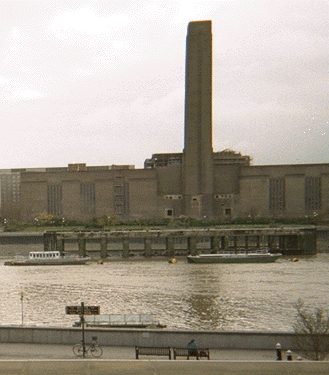
A dark foreboding silhouette against the Thames skyline, this was once Bankside Power Station, disused since 1981. |
The most striking aspect of Bankside Power Station is its single chimney, which was limited to a height of 325 feet so as not to overpower St. Paul's Cathedral. The massive turbine hall alone is 115 feet high and extends across the 500 feet length of the building.
The Project
Architects Jacques Herzog and Pierre de Meuron won the contest to design a modern Tate Gallery space (Tate Modern) from the structure of Bankside Power Station. As the project started, the Millennium Bridge was yet to be conceived.
Tate Modern was scheduled to open in time for the new millennium 2000, and there was much to be done to enable this imaginative vision to be fully realised. In practice the transformation was scaled over several phases, which are still ongoing...
| Power into Art | |
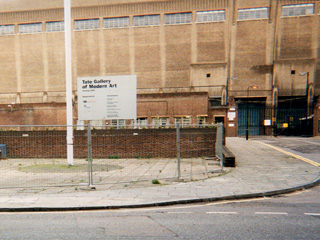 |
Early days and the TV series. |
| Phase 1 | |
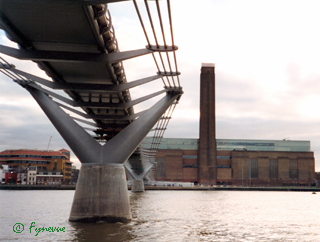 |
Phase 1 of the gallery development benefitted from the opening of the Wobbly Bridge. |
| Phase 2 | |
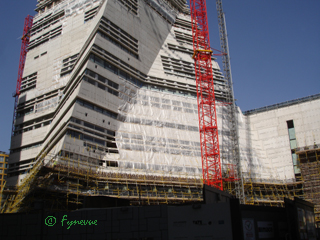 |
Phase 2 development is an extensive building project. |
| Design, images and text compiled by ©
Fynevue. Page last updated
Feb 2016 revision.
Checked June 2024. All logos and trade marks are the property of their respective owners and are used on the Light Straw site(s) for review only. Students and researchers are recommended to make their own independent enquiries as to the accuracy of the information contained therein. |