 |
With the 'White Heat of Technology' of the mid 1960s, Britain was sizzling with hot fashion, ideas and cutting edge solutions... |
The Swinging Sixties saw the opening of the Post Office Tower and a colourful, crazy scene of psychedelic fashions and culture.
Post Office Tower
Opened to the public in May 1966.
Retail
Containerisation
From the late 1960s, goods were shipped in metal boxes (containers) around the globe. This played a big part in the consumer boom and supply of goods in later decades.
"The Box that changed Britain" BBC Four (May 2010) highlighted the fact that it had been more than 40 years since the first container was shipped to the UK.
"Containerisation is so efficient that it costs less to ship goods to Britain from China than it does to drive them up the motorway to the nearest town or city."
"Poet Roger McGough narrated the extraordinary story of how a simple invention - the shipping container - changed the world forever and forced Britain into the modern era of globalisation. With a blend of archive and modern-day filming, the incredible impact of the box was told through the eyes of dockers, seafarers, ship spotters, factory workers and logisticians. From quayside in huge container ports to onboard ships the size of four football pitches, the documentary explained how the shipping container has transformed our communities, economy and coastline."
The Maersk Salalah container ship can carry the equivalent of 8,750 containers-worth of cargo. The yard at the Port of Felixstowe is Britain's biggest container port.
Ercol Furniture
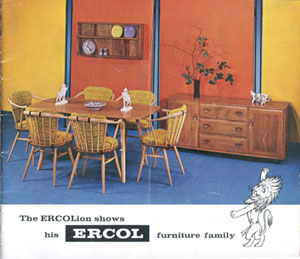 |
The ERCOLion shows his ERCOL furniture family. |
Half-Day Closing
In the 1960s, many smaller shops closed on Wednesday (or Thursday) afternoons. Very few businesses were open on Saturday afternoons and almost all shops were closed on Sundays. Newsagents, chemists and garden centres were general exceptions. The practice of half-day closing was to compensate staff who had to work on Saturdays.
The Sunday Trading Act 1994 made it legal for large shops to trade for up to 6 hours.
Toys
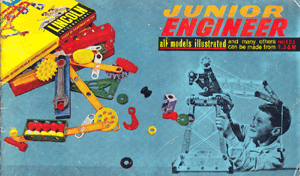 |
Junior Engineer was a plastic construction kit similar to the metal based Meccano. |
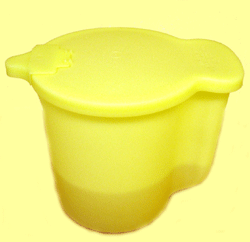 |
The famous Tupperware seal was invented in 1942 by Earl Silas Tupper. Tupperware is THE name for plastic food containers with a resealable air tight (burp) lid. Products were first sold in the USA in 1946. The first Tupperware party in the UK was held in 1960. Today, Tupperware has many 'own brand' imitators and the 'party' culture is less popular than in its heyday in the 1970s. In the USA, Tupperware flourishes, but in the UK the brand has a diminished profile. |
All logos and trade marks are the property of their respective owners and are used on the Light Straw site(s) for review only. Students and researchers are recommended to make their own independent enquiries as to the accuracy of the information contained therein.